Application Modernization

Your legacy platforms are a liability. V.Two Evolve turns them into an advantage

V.Two Evolve modernizes business platforms with AI. Faster than a rewrite. Safer than a lift-and-shift. Priced so the risk sits with us, not you

Why now

The math on legacy platforms has changed

01

Maintenance is eating your budget

Every year, more of your budget goes to keeping old platforms alive. The gap compounds

02

Rewrites keep failing

Traditional rewrites run long and get cancelled, because they depend on humans re-reading millions of lines of code by hand

03

AI changed what's possible

AI can read, map, and help regenerate codebases at speeds no human team can match; firms that apply it with discipline modernize in months, not years

If any of this sounds familiar, we should talk

Your platform is nearing end-of-life

The framework, the runtime, or the on-prem system underneath it is going unsupported, and the clock is ticking

The business rules live only in the code

The people who wrote them are gone. Nobody can say exactly what the system does anymore, only that it can't break

A rewrite feels too risky to start

Going dark for a year and betting the business on one big cutover is not a plan anyone wants to sign

Every change is slow, and getting slower

Shipping anything means touching fragile code, and hiring for the aging stack keeps getting harder

The approach

Modernize the engine without stopping the car

Instead of a risky big-bang rewrite, we grow a modern system around your live one and switch it over a piece at a time. Your users never notice. Your business never stops

✕Legacy & on-prem

  • Aging framework, nearing end-of-life
  • Business logic tangled with the UI
  • Locked to on-prem infrastructure
  • Slow, risky, expensive to change

✓Modern & cloud

  • ✓Current, supported, cloud-native stack
  • ✓Clean API, business rules documented
  • ✓Scales on demand, deploys in minutes
  • ✓Evergreen, and cheaper to run

Clean interface

Your existing interface stays unchanged

Modern

Legacy

Rebuilt

Rebuilt

Migrating

Legacy

Legacy

Legacy

Each module is verified against the extracted user stories and business rules, and validated on the running system, before the legacy version is retired

A working, deployed product at the end of every single phase

Inside the work

A look at how we actually do it

Most firms show you a deck. Here is how the method actually runs, and how we prove every increment holds up before it ships

The method: three stages

Every engagement runs the same defined path, each stage with its own inputs, review gate, and deliverables. The application stays live the entire time

1Discovery
2Blueprint
3Build

01

Discovery

Discovery & assessment

Architecture analysis

Dependency & risk

Business-rule extraction

02

Blueprint

Target Architecture Blueprint

Phased Conversion Roadmap

Part-by-part decomposition

PRDs + implementation plans

03

Build

Module rebuild via Claude Code

Verification against stories & rules

Deployment readiness

Documentation & handoff

How we verify each increment

Nothing legacy is switched off until its modern replacement is verified against the extracted user stories and business rules, and validated on the running system. Every increment clears five gates before it ships:

✓Behavior verified against the extracted stories & rules

✓Conforms to house patterns

✓Security clean

✓No duplicate logic or types

✓Scope limited to the slice

Passing unit tests is not the bar. Verifying each increment against the documented stories and rules, and validating it on the running system, is what lets us retire legacy code without holding our breath

Discovery output

What you get from Discovery

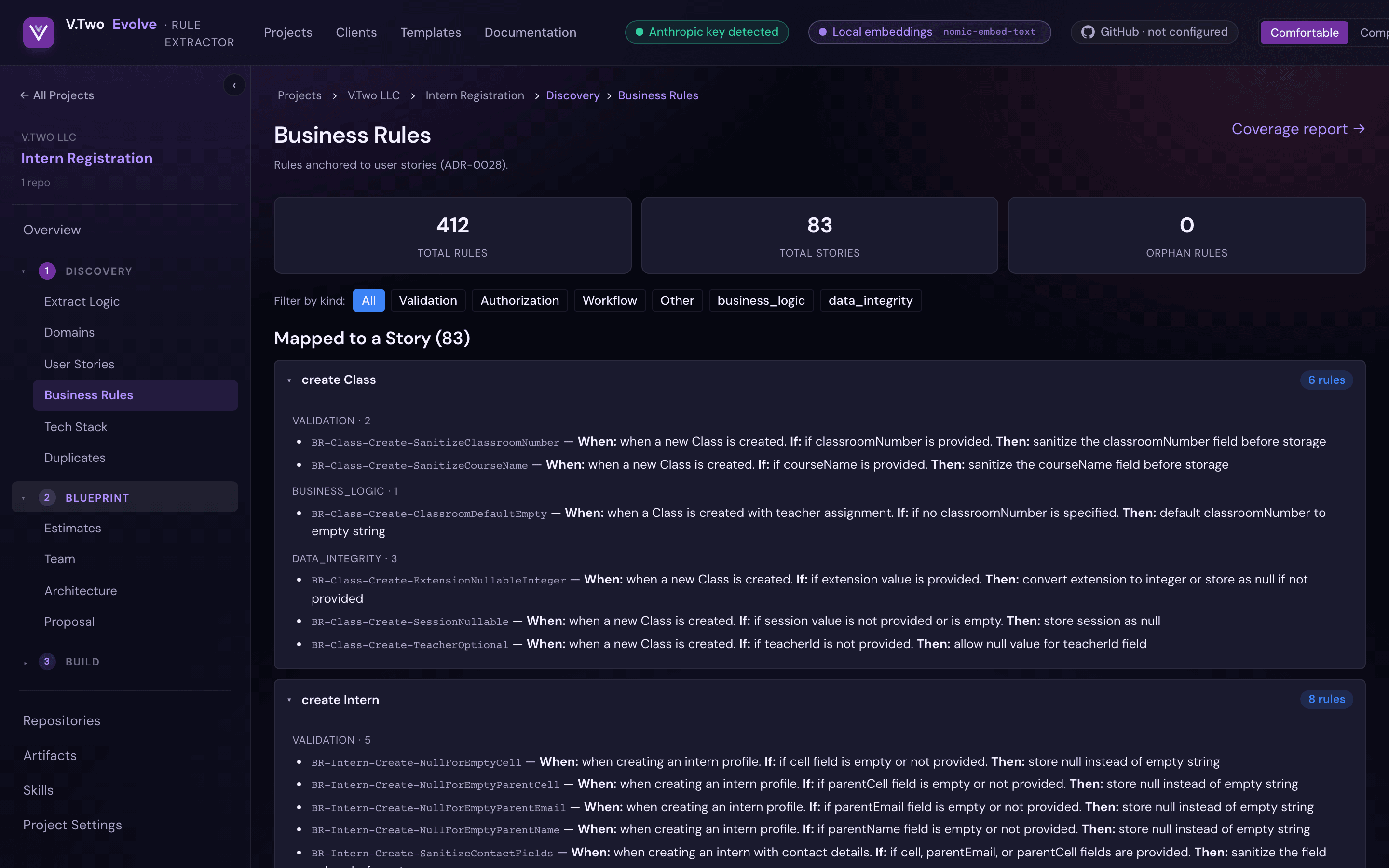
Two artifacts, one lineage. Every route, job, and workflow in your codebase becomes a user story your team recognizes. Every rule those stories run on is recovered, cited, and anchored back to the story that produces it. Nothing orphaned. Nothing guessed
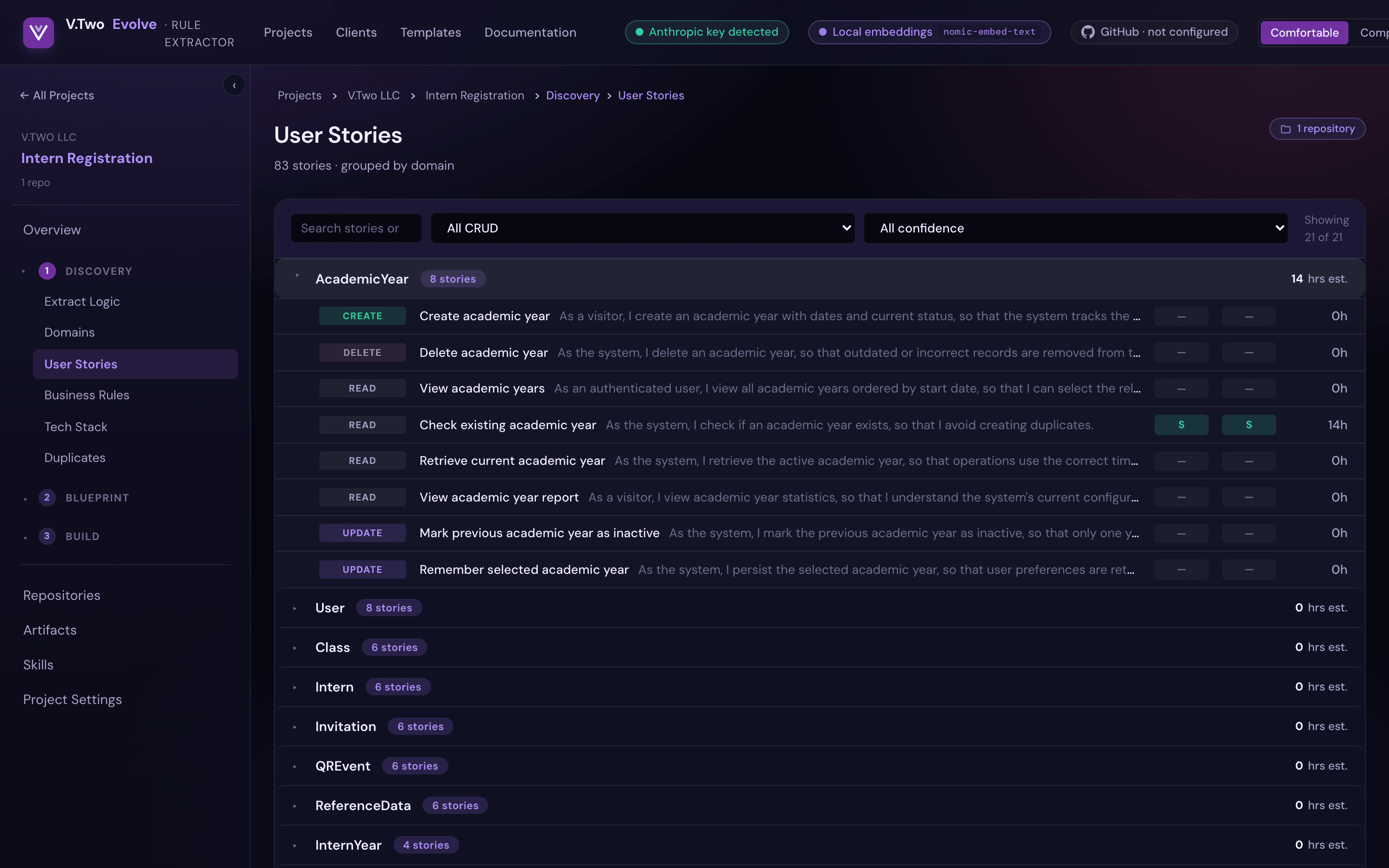
How we recover your business rules

The rules your business runs on are buried in legacy code, undocumented, and often known to no one. Here is the actual pipeline: AI reads the code, we recover each rule into a plain-language spec you own, with a citation to the exact source, so the modern rebuild can be validated against the original behavior

server/src/routes/classes.ts

Source

router.post('/classes', async (req, res) => {
  const { classroomNumber, teacherId } = req.body;

  // strip anything that isn't
  // alphanumeric before persisting
  const clean = classroomNumber
    .replace(/[^a-zA-Z0-9]/g, '');

  const cls = await db.class.create({
    data: { classroomNumber: clean, teacherId },
  });
  res.json(cls);
});

business-rules.yaml

Recovered · owned by you

rule_id: BR-Class-Create-SanitizeClassroomNumber
rule_kind: validation
trigger: When a class is created
condition: classroomNumber contains
  non-alphanumeric characters
action: Strip non-alphanumeric
  characters before persisting
rationale: Classroom numbers must be
  sortable and comparable across records
sources:
  - file: server/src/routes/classes.ts
    start_line: 42
    end_line: 58
confidence: 0.92
provenance: original
parent_story_id: US-Class-Create

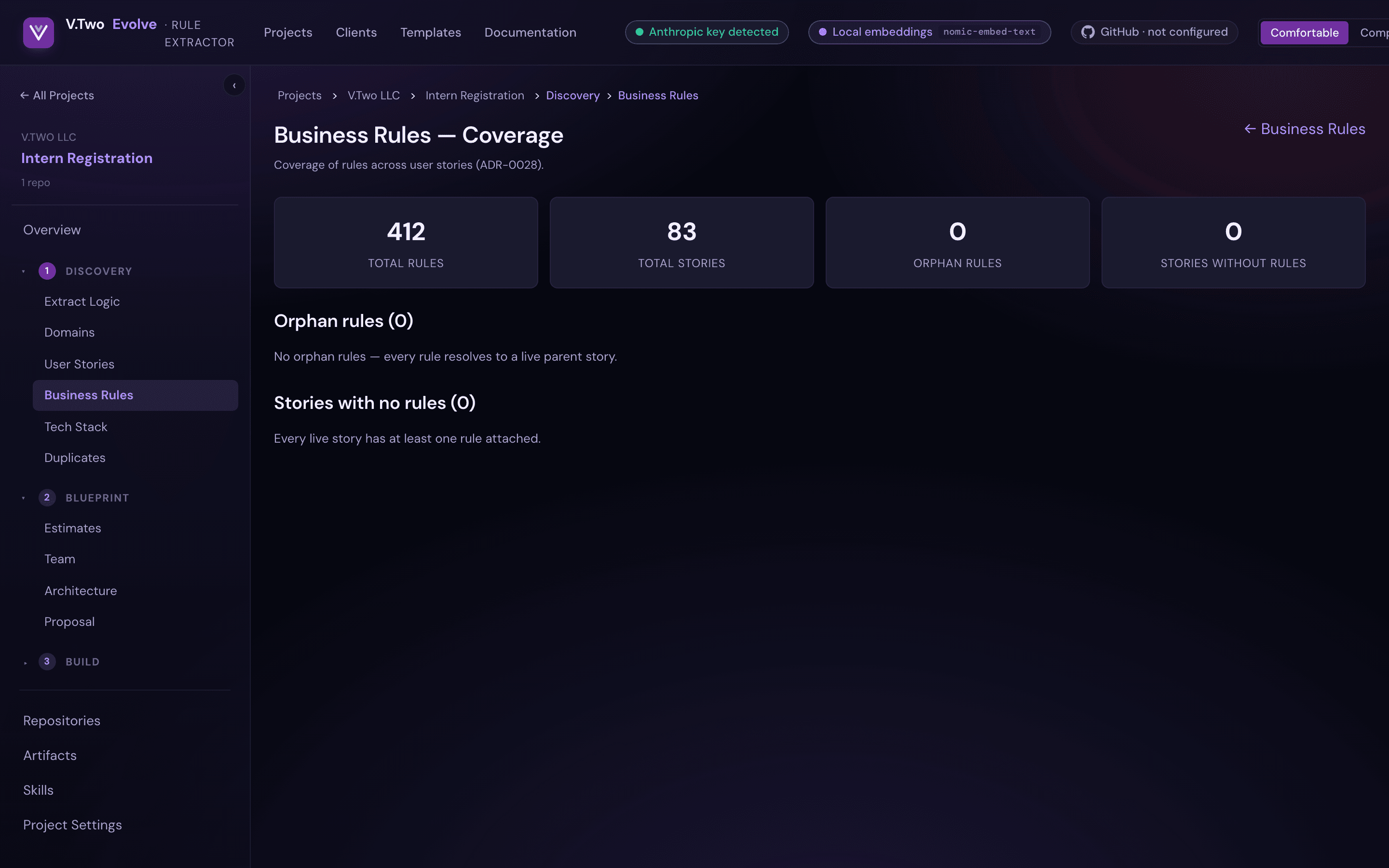
coverage-check

Anchored to stories

total_stories: 83
total_rules: 412
orphan_rules: 0
stories_without_rules: 0

# Every rule anchored to a story.
# Every story has explicit rules.
# Nothing lost between extraction
# and specification.

The export format is a machine-checkable schema, so every recovered rule is validated, cited, and reviewed and curated by your domain experts before it drives a single line of the rebuild. You end up owning a complete, plain-language specification of a system that used to live only in code

The hard part is the edge cases nobody remembers

Extracting the obvious rules is easy. The value is in the rules that are conditional, date-sensitive, or quietly special-cased. The ones that pass a rewrite's unit tests and still get month-end billing wrong. Take tax:

server/src/lib/tax.ts

Source

export function computeTax(invoice) {
  const taxable = invoice.lines
    .filter(l => l.isTaxable)
    .reduce((sum, l) => sum + l.total, 0);

  // rate as of the invoice date,
  // NOT today's rate
  const rate = rateOn(invoice.date);

  return round2(taxable * rate);
}

business-rules.yaml

Needs domain sign-off

rule_id: BR-Invoice-Tax-DateScopedRate
rule_kind: business_logic
trigger: When an invoice is finalized
condition: invoice contains lines where
  isTaxable = true
action: Sum taxable-line totals and
  multiply by the rate in effect on the
  invoice date; return 0.00 (not null)
  when no lines are taxable
rationale: Back-dated invoices must use
  the historical rate, not today's rate
sources:
  - file: server/src/lib/tax.ts
    start_line: 40
    end_line: 77
confidence: 0.71
provenance: inferred
parent_story_id: US-Invoice-Finalize

A rewrite that “looks right” would use today's tax rate and return null for an untaxed invoice. Both are wrong, and both are invisible until a client's month-end. Because these rules are inferred, not certain, we flag them for the domain owner to confirm before the rebuild starts

Not just math: who can do what, and when

The rules that govern authority and approval flows are where the real risk lives, and they are almost never written down. We recover those too

validation

authorization

business_logic

data_integrity

workflow

other

authorization rule

Who can do what

rule_id: BR-Billing-WriteOffWip-AuthorizedRoles
rule_kind: authorization
trigger: When a user attempts to write
  off WIP on a matter
condition: actor.role in
  [ResponsiblePartner, BillingManager]
  AND amount <= actor.approvalLimit
  AND matter.status != 'locked'
action: Allow the write-off; otherwise
  reject with a permission error
rationale: Locked matters block all
  write-offs, and delegated authority
  expires with the delegation, not the
  matter
sources:
  - file: server/src/routes/billing.ts
    start_line: 112
    end_line: 149
confidence: 0.68
provenance: inferred
parent_story_id: US-Billing-WriteOffWip

workflow rule

Approval flow

rule_id: BR-Bill-Finalize-PartnerApprovalChain
rule_kind: workflow
trigger: When a draft bill is submitted
  for finalization
condition: bill.state transitions across
  draft → pending → approved → final;
  bills over matter.threshold require a
  second approver
action: Advance the bill through the
  approval chain; a rejected bill returns
  to draft (not pending) and the chain
  resets; approvals are voided if the
  total changes after sign-off
rationale: Approval authority is scoped
  to the amount at time of sign-off
sources:
  - file: server/src/lib/bill-workflow.ts
    start_line: 64
    end_line: 120
confidence: 0.74
provenance: inferred
parent_story_id: US-Bill-Finalize

These are the rules a rewrite gets subtly wrong: an approval that should have reset, a delegated authority that should have expired, a threshold that quietly moved. Every one is recovered, cited, and reviewed against the running system before the rebuild ships

How we work

Not a product. A way of working

Evolve is two things: a Discovery product that reads your codebase, and a delivery method for the modern rebuild

Modernization at this pace was not possible three years ago. Large language models, agent workflows, AST parsing, and semantic search over code have changed what a small, senior team can hold in view at once. Evolve is how we put those capabilities to work, on real production systems, with humans in the loop where it matters

Skills

The human + AI craft. Architects who know how to prompt, review, and steer LLMs against a real codebase — deep familiarity with legacy patterns and a working taste for what to preserve versus rewrite. The AI is the leverage; the judgment is ours

Context

How we gather what the model needs to be useful. Code, via tree-sitter AST parsing and dependency graphs. Prior architectural decisions, via the ADR log. People, via SME interviews. AI lets a small team hold all of that in view at once — the thing no human team could do by hand

Methods

The repeatable AI-driven techniques. Rule extraction with two-pass LLM synthesis. Semantic search across the codebase via embeddings. Architect-in-the-loop code generation. Incremental cutover paths that let old and new run side by side. Governed end to end by the V.Two AI SDLC

V.Two Evolve is the application-modernization edge of V.Two's Digital Transformation practice

Why V.Two

Why clients pick us

Plenty of firms will quote you a modernization project. Here is why clients pick us

SEE OUR WORK AT V.TWO →

This is the only thing we do

Application modernization with AI is not a side practice for us. It is the work. V.Two Evolve exists because we have done this on real platforms, refined the method each time, and codified what works

Fixed bid. Risk removed

Free assessment. Fixed-fee pilot. Fixed-fee build. You know every price before you commit, and overruns are our problem, not yours. No firm billing by the hour can say that

A proven partner

We have shipped modernization work for real clients on real production systems. Our references speak to delivery, not decks

References, on request

Client references available on request

Deliverables

What you walk away with

Not just working software, but a documented, understood platform your team owns. Every engagement produces:

✓Application Assessment Report

✓Architecture, data-source & coverage maps

✓Dependency & Risk Register

✓Target Architecture Blueprint & ADRs

✓Phased Conversion Roadmap & Estimate

✓Business-Rule Specifications you own

✓Modernized codebase, delivered incrementally

✓Acceptance Criteria & Rule Evidence

✓Deployment Runbook & Rollback Procedure

✓Handoff Package & Knowledge Transfer

FAQ

Frequently asked questions

What platforms and languages do you work with?

⌄

Today, V.Two Evolve supports JavaScript, TypeScript, and PHP (Laravel). The method itself is language-agnostic — additional stacks (Java, .NET, COBOL) are added per engagement

Is our code used to train AI models?

⌄

No. We operate under enterprise agreements with no training on client data. Every engagement includes review gates and access controls

What if the pilot does not deliver?

⌄

Then you found out early, with hard benchmarks, instead of discovering it two years into a rewrite. The pilot is deliberately small and fixed-scope so that is a cheap lesson, not an expensive one

How is this different from a big consultancy?

⌄

Consultancies sell hours, so longer projects pay them more. V.Two sells fixed-fee outcomes, so speed pays V.Two

Ready to start?

1

Talk to us

30-minute call

2

Free assessment

Codebase scan and roadmap

3

Pilot in weeks

Fixed-fee, judge us on shipped code